Scroll down for episode descriptions, show notes, and guest introductions as we follow our grandfather’s World War II journey one story at a time.
Snapshots of WWII: Into the Hedgerows – The Fight Moves Inland
Season 1, Episode 6 — Season Finale
June 10–11, 1944. Just four days after D-Day, the beaches are behind the men of the 357th Infantry Regiment. Now they are moving deeper into Normandy and into a very different kind of war.
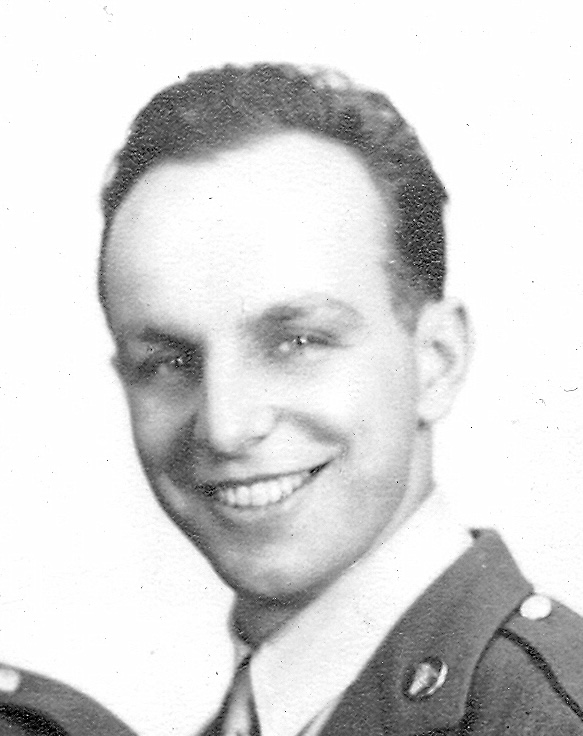
In this season finale of Snapshots of WWII: Sisters Explore Their Grandfather’s Legacy, we follow the 357th Infantry Regiment Medical Detachment as they move inland toward Amfreville and into the dense hedgerow country of Normandy. Among them was our grandfather, Malcolm, whose wartime records place him with the 90th Infantry Division as the battle for Normandy began to unfold.
Into the Hedgerows
The June 10th minute report reads: “Left Loutres at 0100 hours, enemy contacted at 0600 hours, distance traveled by foot four miles.”
It’s only a few words, but they mark a major turning point. The men left in darkness, moving carefully through unfamiliar territory, knowing German forces were somewhere ahead. Five hours later, they made contact with the enemy.
The following day’s report is even shorter: “Amfreville. Distance traveled by foot two miles.”
On paper, two miles doesn’t sound like much. But in combat, distance can measure resistance. Every field and hedgerow had to be approached carefully, and every advance could bring an ambush.
The Hedgerow War
Normandy’s hedgerows were massive earthworks built over generations, with thick banks, deep roots, stone, trees, and dense vegetation. They created natural walls between fields and made visibility extremely limited.
German infantry, machine-gun teams, mortars, and snipers could use these hedgerows as defensive positions. The fighting became fragmented and unpredictable, with soldiers moving from field to field and hedgerow to hedgerow.
For the medics, the danger was especially difficult. They had to move through the same terrain and under the same enemy fire to reach wounded soldiers, often without the ability to defend themselves in the way infantrymen could.
They were no longer behind the lines.
They were inside them.
The 90th Infantry Division
The early days of combat were difficult for the 90th Infantry Division. Many of the soldiers were new to combat, and the division faced unfamiliar terrain, communication problems, disorganization, and leadership challenges.
General Omar Bradley later criticized the division’s early performance, and leadership changes began while the fighting was still underway.
But this was also a division learning under fire. The men adapted, tactics evolved, and experience came quickly.
For the medics, however, the mission never changed. The wounded still needed help, and someone still had to move toward them.
Our Grandfather’s Story
This is where the official records become especially meaningful to us.
When we read the words “enemy contacted,” we know they represent a moment our grandfather experienced firsthand. But the records don’t tell us what he felt.
Was he afraid? Did he hesitate? Or did training simply take over?
We’ll never know for certain.
Our grandfather rarely spoke about his wartime experiences, but he preserved photographs and military records from his service. Those records tell us where he was and when his unit moved, but they don’t tell us what he saw, heard, or carried with him afterward.
Somewhere in those hedgerows was a young man being asked to move toward danger for someone else.
He was a medic.
His job was to save lives.
And he kept going.
Why This Episode Matters
June 10th and 11th mark a turning point not only in our grandfather’s story but in the larger Normandy campaign. The 357th was moving toward Amfreville and the Merderet River while American forces worked to expand the beachhead and connect with airborne units.
The terrain slowed them down, German resistance made every advance costly, and the 90th Infantry Division was learning how to fight in conditions unlike anything they had experienced before.
For the medics, there was no stepping back while the division found its footing. They moved forward with everyone else, reaching the wounded one field at a time.
Closing Out Season One
With this episode, we’re closing out Season One of Snapshots of WWII: Sisters Explore Their Grandfather’s Legacy.
We’ve followed our grandfather from Camp Kilmer, across the Atlantic, through training in England, onto Utah Beach, and now into the first days of combat in Normandy.
Season One has been about beginnings: preparation, the crossing, the landing, and those first uncertain steps into war.
Season Two will pick up where we leave off, following the 357th medics deeper into Normandy’s hedgerow fighting and beyond. We’ll explore how the 90th Infantry Division adapted under fire, the challenges faced by combat medics, and the battles that shaped the men who fought them.
We’ll continue using military records, minute reports, firsthand accounts, photographs, and historical research to retrace our grandfather’s journey and the experiences of the thousands who served alongside him.
In This Episode
We explore the 357th Infantry Regiment’s movement from Loutres toward Amfreville, the first recorded “enemy contacted” entry, the challenges of Normandy’s hedgerows, German defensive positions, and the early combat experiences of the 90th Infantry Division.
We also look at what those records mean to us personally as we try to understand what our grandfather experienced during those first days of combat.
Show Notes & Resources
Please see the show notes below for download:
💛 Support the Roots Revival Fund
If you’d like to support this project, you can contribute here: https://rootsofdiscovery.me/roots-revival-fund/
Your support helps fund podcast production, WWII archival research, and travel to historical sites connected to our grandfather and other service members.
Where to Find Us
🎙️ Podcast: Snapshots of WWII
🎧 Spotify: Listen on Spotify
🎧 Apple Podcasts: Listen on Apple Podcasts
🌐 Website: Roots of Discovery
📷 Instagram: @rootsofdiscovery
🎥 YouTube: @rootsofdiscovery
🎧 TikTok: @rootsofdiscovery
📝 Full Blog + Show Notes: Roots of Discovery
Thank You for Listening
Thank you for joining us throughout Season One of Snapshots of WWII: Sisters Explore Their Grandfather’s Legacy.
If this story has moved you, we’d be grateful if you left a five-star review. It helps others discover the show and keeps these stories alive.
We’d also love to hear from you. If your family has a wartime story or a quiet hero whose story deserves to be remembered, share it with us. Every story adds another piece to the legacy.
Thank you for listening, remembering, and honoring our grandfather alongside us.
We’ll see you in Season Two as we continue further into history.
Until next time, stay curious and keep remembering.
Snapshots of WWII: D-Day – A Combat Medic’s First Hours in Normandy
Season 1, Episode 5
June 6, 1944. History remembers D-Day for the thousands of soldiers who stormed the beaches of Normandy. But behind every assault wave were combat medics—young men who landed without weapons, carrying only the supplies needed to save lives.
In this episode of Snapshots of WWII, we follow the 357th Infantry Regiment Medical Detachment as they come ashore on Utah Beach during the largest amphibious invasion in history. Among them was our grandfather, Malcolm, whose wartime records place him with the 90th Infantry Division as the battle for Normandy began.
The official reports tell us where the unit landed. They don’t tell us what it felt like to be there.
Landing on Utah Beach
The 357th Infantry Regiment landed on Utah Beach as part of the second wave of the 90th Infantry Division. Although the beachhead was more secure than Omaha Beach, the fighting was far from over. German artillery, machine-gun fire, flooded fields, and scattered units created a battlefield filled with uncertainty.
For the medics, every step inland meant moving toward wounded soldiers while carrying little more than bandages, morphine, plasma, and hope.
Featured Guest: John C. McManus
Joining us is acclaimed military historian John C. McManus, one of the foremost authorities on the 90th Infantry Division and the Normandy campaign.
Drawing on decades of research, firsthand accounts, and official records, John explains what combat medics faced during the opening hours of D-Day—from impossible triage decisions and shortages of medical supplies to the extraordinary courage required to save lives while under fire.
His perspective helps bridge the gap between the official reports and the human experience of the soldiers who lived them.
John C. McManus is an award-winning military historian, author, and professor specializing in World War II and American military history. His research on the 90th Infantry Division, D-Day, and the Normandy campaign has helped preserve the stories of the soldiers who fought there. Through his books, podcasts, and public history work, John brings the human experience of war to life using firsthand accounts, military records, and decades of archival research.
Connect with John
Official Website: https://johncmcmanus.com
Featured Book Mentioned
Podcasts
- Someone Talked! (in partnership with the National D-Day Memorial)
- World War II Live (with Kevin Hymel)
- We Have Ways USA (with James Holland and Al Murray)
Contact
Visit John’s website to find his university contact information and additional ways to connect.
If you enjoy military history, be sure to explore John’s books and podcasts for more in-depth discussions on World War II, D-Day, Normandy, and the experiences of the American soldier.
In This Episode
- The 357th Infantry Regiment’s landing on Utah Beach
- Combat medics during the first hours of D-Day
- Medical care under enemy fire
- Challenges of evacuation and battlefield triage
- The 90th Infantry Division’s mission inland
- Flooded terrain, causeways, and German resistance
- Missing military records and what historians use to fill the gaps
- Insights from historian John C. McManus
Why This Episode Matters
Our grandfather rarely spoke about his wartime experiences, but he carefully preserved photographs and military records from his service as a frontline medic. Those records place him on Utah Beach on June 6, 1944, even when the details of those first hours went unwritten.
Through historical research, firsthand accounts, and expert insight, we’re piecing together the story behind those silent pages—revealing not only where he was, but what he likely witnessed as he carried his medic’s bag into one of history’s defining battles.
D-Day wasn’t just about taking the beaches. For combat medics, it was about preserving life in the middle of unimaginable destruction.
Join us as we retrace our grandfather’s first hours in Normandy and explore the courage of the men who ran toward the wounded when everyone else was seeking cover.
Show Notes & Resources
Please see the show notes below for download:
💛 Support the Roots Revival Fund
If you’d like to support this project, you can contribute here: https://rootsofdiscovery.me/roots-revival-fund/
Your support helps fund podcast production, WWII archival research, and travel to historical sites connected to our grandfather and other service members.
Where to Find Us
🎙️ Podcast: Snapshots of WWII
🎧 Spotify: Listen on Spotify
🎧 Apple Podcasts: Listen on Apple Podcasts
🌐 Website: Roots of Discovery
📷 Instagram: Instagram @rootsofdiscovery
🎥 YouTube: YouTube @rootsofdiscovery
🎧 TikTok: @rootsofdiscovery
📝 Full Blog + Show Notes: Snapshots of WWII Podcast Page
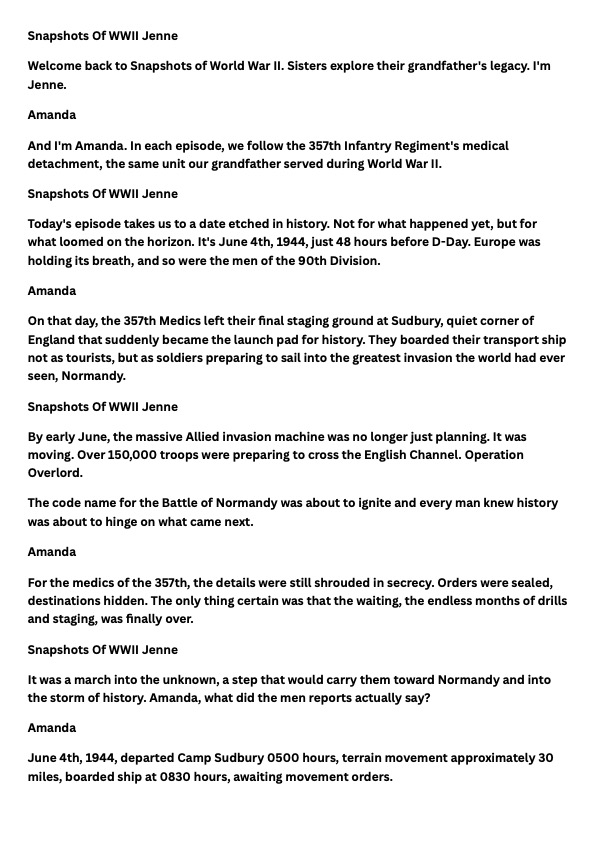
Snapshots of WWII: June 4, 1944 — Boarding the Unknown
Season 1, Episode 4 of 6
There are moments in history when everything changes, even if the people living through them don’t realize it yet.
For the men of the 357th Infantry Regiment Medical Detachment, June 4, 1944 was one of those moments. After months of training, inspections, and waiting in England, they were finally on the move. Somewhere across the English Channel, Allied forces were preparing to launch the largest amphibious invasion in history.
The soldiers didn’t know exactly where they would land or what awaited them. They only knew the waiting was over.
Episode 4 of Snapshots of WWII follows our grandfather and the men of the 357th Medical Detachment as they left their final staging area in England and boarded ships bound for Normandy. It was the day they stepped out of preparation and into history.
Leaving Camp Sedbury
Military reports often reduce life-changing moments to a few simple lines. The report for June 4, 1944 reads:
“Departed Camp Sedbury 0500 hours. Terrain movement approximately 30 miles. Boarded ship at 0830 hours. Awaiting movement orders.”
At first glance, it seems routine. But behind those words was one of the most significant days of our grandfather’s wartime journey.
Before dawn, the men packed their gear and formed ranks for departure. They marched through the streets of Chepstow beneath gray skies, passing civilians who had grown accustomed to seeing American soldiers moving through town.
To the locals, it may have looked like another military movement. To the soldiers, it was something entirely different. The training was over. The invasion was about to begin.
Boarding the Ship
By 8:30 that morning, the men were climbing aboard transport ships waiting in southern England’s ports. The official reports don’t identify the vessel, but the docks would have been filled with soldiers, vehicles, ammunition, and supplies all moving toward the same objective.
For our grandfather and the medics of the 357th, boarding the ship marked a turning point. There would be no more training exercises or rehearsals. The next shore they expected to see would be France.
The invasion force was assembled. History was in motion.
Life Aboard the Transport
Once aboard, the soldiers entered a strange period of waiting.
The ships were crowded with men and equipment. Hammocks hung close together, passageways were packed with gear, and the smells of oil, seawater, and diesel filled the air. Some soldiers wrote letters home while others talked quietly with friends or sat alone with their thoughts.
For the medics, preparation continued. Bandages, morphine syrettes, and medical supplies were checked repeatedly. They knew that once the invasion began, wounded men would depend on them.
As we researched this chapter of Grandpa’s story, we found ourselves imagining him aboard that ship at just twenty-three years old, reviewing his equipment and preparing for a future he couldn’t yet see.
When the Weather Changed History
The invasion was originally scheduled for June 5, 1944. Then the weather turned.
High winds and rough seas swept across the English Channel, threatening both the landings and airborne operations. After consulting with his commanders and meteorologists, General Dwight D. Eisenhower made one of the most consequential decisions of the war.
The invasion would be delayed by twenty-four hours. For historians, it became a pivotal moment. For the soldiers aboard ship, it meant another day of waiting and wondering what lay ahead.
The Human Side of Waiting
One of the most memorable moments in this episode comes from the recollections of John Santillo of the 237th Engineer Combat Battalion.
Years later, Santillo described how troops had already begun moving across the Channel when orders came to turn back because of the storm. His memories capture the uncertainty and tension of those final days before D-Day.
History often focuses on plans, operations, and commanders. Santillo reminds us that history is also about ordinary people trying to process fear, hope, and uncertainty. For those soldiers, D-Day wasn’t a famous event yet.
It was tomorrow.
Featured Historical Voice
John Santillo (1924–2020) served in the U.S. Army’s 237th Engineer Combat Battalion during World War II. In this episode, we share excerpts from his oral history interview recorded on May 23, 2012, for the Veterans History Project. Santillo vividly recalled the tension leading up to D-Day, including the weather delay that forced invasion forces to temporarily turn back before the historic June 6 landings.
His firsthand account provides a powerful reminder that behind every military operation were young men facing uncertainty, fear, and the unknown.
👉 Listen to and view John Santillo’s full interview through the Veterans History Project at the Library of Congress:
https://www.loc.gov/programs/veterans-history-project/
👉 View John Santillo’s Veterans Legacy Memorial profile:
https://www.vlm.cem.va.gov/
John Santillo passed away on December 9, 2020, but his story continues to educate and inspire future generations through these preserved oral histories.
Why This Story Matters to Us
As sisters retracing our grandfather’s wartime journey, this episode made us think about him differently.
There are no battle scenes here. No dramatic victories. Just a young medic sitting aboard a crowded ship, carrying medical supplies and preparing for whatever came next. Our grandfather wasn’t thinking about history. He was focused on the mission ahead and the men he might soon be called upon to save.
That may be what makes this chapter so meaningful.June 4, 1944 was the last quiet moment before everything changed.
And our grandfather was there.
Show Notes & Resources
Please see the show notes below for download:
💛 Support the Roots Revival Fund
If you’d like to support this project, you can contribute here: https://rootsofdiscovery.me/roots-revival-fund/
Your support helps fund podcast production, WWII archival research, and travel to historical sites connected to our grandfather and other service members.
Where to Find Us
🎙️ Podcast: Snapshots of WWII
🎧 Spotify: Listen on Spotify
🎧 Apple Podcasts: Listen on Apple Podcasts
🌐 Website: Roots of Discovery
📷 Instagram: Instagram @rootsofdiscovery
🎥 YouTube: YouTube @rootsofdiscovery
🎧 TikTok: @rootsofdiscovery
📝 Full Blog + Show Notes: Snapshots of WWII Podcast Page
Snapshots of WWII: The Waiting Game: Final Preparations in the British Countryside
Season 1, Episode 3 of 6
There are moments in history when everything seems quiet on the surface, but underneath, the world is changing.
Episode 3 of Snapshots of WWII follows our grandfather and the 357th Infantry Regiment Medical Detachment as they continued their journey through England during the spring of 1944. Their destination was still unknown to them, but every movement, every training exercise, and every new camp brought them one step closer to one of the most important military operations in history.
By April and May of 1944, the Allies were preparing for the invasion of Nazi-occupied France. Thousands of soldiers were being repositioned across southern England, secrecy was tightening, and the final pieces of Operation Overlord were quietly falling into place.
Our grandfather was right in the middle of it.
From Kidderminster to Camp Sedbury
Following their arrival in England, the 357th Medical Detachment remained near Kidderminster for orientation and field training. Military reports show that in early May, the unit was transported to Camp Sedbury near Lydney, Gloucestershire.
On paper, it looks like a simple change of location.But when we dug deeper, we realized these weren’t ordinary moves. Camp Sedbury was one of many temporary staging camps established to prepare Allied forces for the invasion of Europe.
Nestled along the River Severn, the countryside may have appeared peaceful, but the area was filled with military activity. Troops trained daily, equipment was inspected, and preparations intensified.
For medics like our grandfather, every day meant more field exercises, more medical readiness training, and more anticipation about what might be coming next.
Racecourse Camp and Preparing for the Unknown
The next stop was Racecourse Camp near Chepstow, Wales.Built around a horse racing track, the camp became home to thousands of soldiers awaiting future orders. Conditions were often muddy, crowded, and uncomfortable, but there was important work to be done.
Medical kits, bandages, surgical supplies, and essential gear all had to be protected from water. At the time, the soldiers likely viewed it as another task on a long list of preparations.
Today, we know why it mattered. They were preparing for an amphibious invasion. As we researched this section of Grandpa’s journey, we found ourselves imagining him carefully checking supplies, organizing medical equipment, and making sure everything would survive conditions he couldn’t yet predict.
The men knew something important was coming. They just didn’t know exactly what.
Invasion Fever
One of the most powerful discoveries during our research came from the official history of the 90th Infantry Division. The division described these months as a time of “invasion fever.”
Rumors spread constantly. Soldiers speculated about where they might go and when they might leave. Every movement order felt significant. Every delay felt endless.
Meanwhile, German forces were watching and waiting across the English Channel. History tells us that both sides knew an invasion was coming. The only question was when and where. For the soldiers training in England, patience became part of their daily routine.
A Historian’s Perspective on the Final Weeks Before D-Day
One of the highlights of this episode was speaking with WWII historian Paul Woodadge.
Paul has dedicated years to studying the events leading up to D-Day and helping others understand the enormous scale of Operation Overlord. His insight brought an entirely new perspective to these seemingly quiet weeks in England.
When we first looked at Grandpa’s military reports, they felt almost routine. The entries were brief: units moved, training continued, equipment was prepared. But hearing Paul explain what was happening across England at that same moment helped us see those records in a completely different light.
Behind every movement order was a massive operation involving hundreds of thousands of Allied troops. Temporary camps like Camp Sedbury and Racecourse Camp weren’t simply places to sleep—they were pieces of one of the largest military preparations in history.
Paul helped us understand that while our grandfather and his fellow soldiers may not have known exactly where they were going, they were participating in the final stages of a plan that would change the course of the war.
Hearing his perspective made those simple military reports feel heavier. Suddenly, those lines on paper represented young men standing on the edge of history.
The Human Side of Waiting
One thing we’ve learned through this project is that military records rarely capture emotions. The reports tell us where the unit moved, what training occurred, and when equipment inspections took place.
They don’t tell us what the men were thinking. They don’t tell us whether they were scared. They don’t tell us how often they thought about home.
As sisters retracing our grandfather’s journey nearly eighty years later, those are the questions we find ourselves asking most often.
What did he feel standing in those camps? Did he realize how close he was to history? Did he know that within weeks he would be crossing the English Channel into combat?
We’ll probably never know.
But researching these weeks reminded us that behind every military report was a young man carrying hopes, fears, and responsibilities far beyond his years.
Why This Story Matters to Us
This podcast began with photographs.
Our grandfather Malcolm left behind hundreds of photographs from his time serving as a frontline medic during World War II. What started as a desire to identify locations slowly transformed into a journey through his entire wartime experience.
Today, we’re following his path through Europe, researching his movements, restoring his photographs, and visiting many of the same locations he saw during the war.
Episode 3 represents a unique moment in that journey. The training was nearly complete. The waiting was almost over. The men of the 357th Medical Detachment stood on the edge of history without fully realizing it.
And our grandfather stood among them.
Honestly, this episode made us think about him differently. Not as a soldier in a famous campaign, but as a young man living through weeks of uncertainty, preparing for a future he couldn’t see yet.
Episode 3 Highlights
In this episode of Snapshots of WWII, we cover:
- Camp Sedbury and military staging areas in England
- Racecourse Camp near Chepstow, Wales
- Medical detachment field training
- Waterproofing equipment for amphibious operations
- The 90th Infantry Division’s preparations for D-Day
- Secrecy and movement orders before the invasion
- Insights from historian Paul Woodadge
- Daily life for American soldiers in southern England
- The emotional reality of waiting for war
Show Notes & Resources
Please see the show notes below for download:
Key Topics in This Episode
- Camp Sedbury
- Racecourse Camp
- Chepstow, Wales
- Gloucestershire, England
- 357th Infantry Regiment Medical Detachment
- 90th Infantry Division
- Operation Overlord
- D-Day preparations
- Military staging camps
- WWII medic training
- Waterproofing military equipment
- Paul Woodadge
- Allied invasion planning
Key Locations Mentioned
- Kidderminster, England
- Camp Sedbury, Gloucestershire
- River Severn
- Chepstow, Monmouthshire, Wales
- Racecourse Camp
- Southern England staging areas
Featured Stories & Historical References
- Official 90th Infantry Division histories
- Unit movement reports from spring 1944
- Preparations for Operation Overlord
- Military staging operations throughout England and Wales
- Historical analysis from Paul Woodadge
- The final weeks before D-Day
Featured Guest
Paul Woodadge is a British-born battlefield guide, historian, author, and WWII consultant based in Normandy, France. Internationally recognized as one of the leading authorities on the 1944 D-Day landings and the Battle of Normandy, Paul has dedicated his career to researching, preserving, and sharing the history of World War II. Known for his engaging storytelling and deep historical knowledge, he brings the events of the war to life for audiences ranging from history enthusiasts to military professionals around the world.
💛 Support the Roots Revival Fund
If you’d like to support this project, you can contribute through the Roots Revival Fund.
Your support helps fund podcast production, WWII archival research, photograph preservation, and travel to historical locations connected to our grandfather and the soldiers who served beside him. Click here!
Where to Find Us
🎙️ Podcast: Snapshots of WWII
🎧 Spotify: Listen on Spotify
🎧 Apple Podcasts: Listen on Apple Podcasts
🌐 Website: Roots of Discovery
📷 Instagram: Instagram @rootsofdiscovery
🎥 YouTube: YouTube @rootsofdiscovery
🎧 TikTok: @rootsofdiscovery
📝 Full Blog + Show Notes: Snapshots of WWII Podcast Page
Thank you for joining us as we continue retracing Grandpa’s journey—one report, one photograph, and one story at a time. Next week, the waiting ends. The 357th receives its orders and begins moving toward the coast.
Snapshots of WWII: Across the Atlantic: Arrival in Wartime England
Season 1, Episode 2 of 6
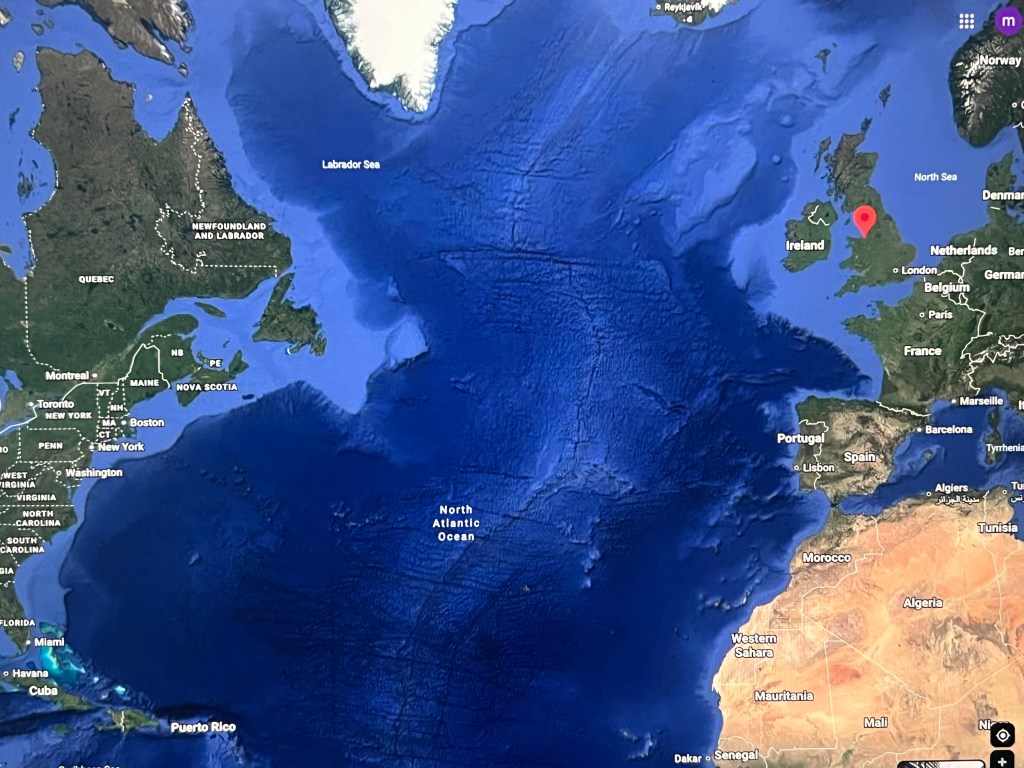
There are parts of World War II history that often get skipped over. We hear about the battles, the beaches, and the victories—but not always the waiting. Not always the crossing. Episode 2 of Snapshots of WWII follows our grandfather and the 357th Infantry Regiment Medical Detachment as they left behind everything familiar and crossed the Atlantic toward war in the spring of 1944.
By this point, the journey had already become real. Camp Kilmer was behind them. Home was fading into the distance. Ahead was England, D-Day preparations, and an unknown future none of them could fully imagine yet.
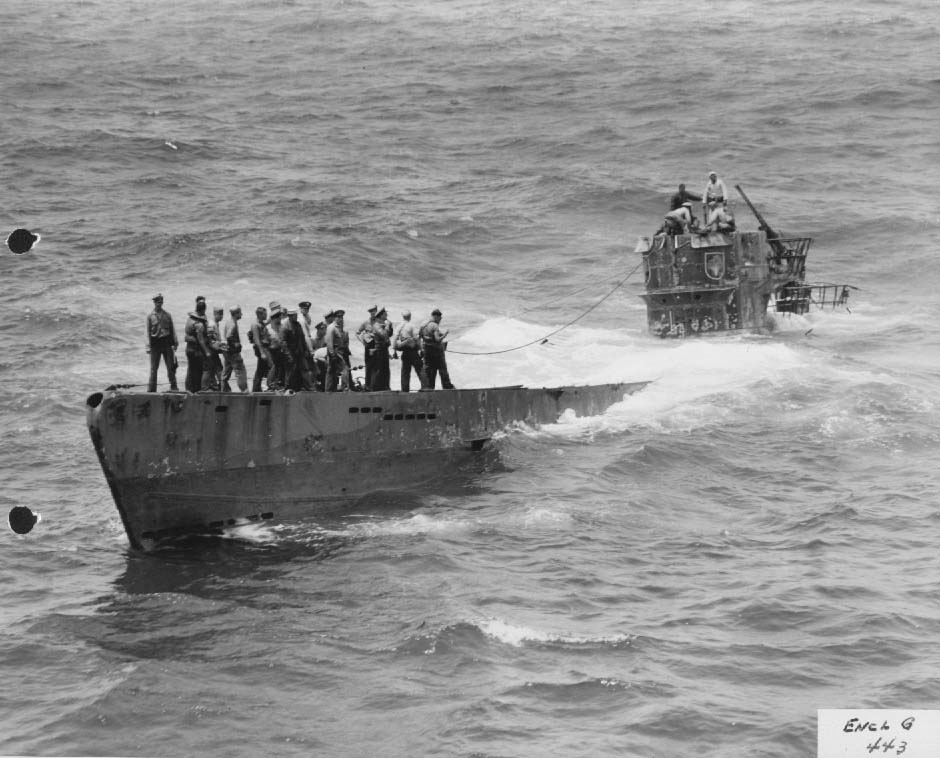
This episode became one of the most emotional for us to research because the records are so simple on paper: departed New York, crossed Atlantic, arrived Liverpool. But behind those few words were thousands of young soldiers packed onto troop ships sailing through dangerous waters hunted by German U-boats.
Crossing the Atlantic During World War II
Our grandfather crossed the Atlantic aboard the HMS Dominion Monarch, a British luxury liner converted into a wartime troop transport ship. By 1944, elegance had long disappeared from ships like these. Troops slept in cramped bunks stacked four high, stood in endless food lines, rationed water, endured blackout drills, and lived with the constant fear of submarine attack beneath the waves.
The military records describe the Atlantic crossing as “uneventful,” but history tells a different story. Convoys zigzagged through U-boat infested waters while soldiers practiced emergency drills day and night. Seasickness spread through overcrowded ships, nerves were stretched thin, and many young men had never even seen the ocean before.
When we researched this part of Grandpa’s journey, it stopped feeling like a military movement report and started feeling deeply human. We imagined him standing on deck watching the Statue of Liberty disappear into the distance—not knowing if he would ever see home again.
WWII Oral Histories That Helped Bring This Episode to Life
One of the most powerful moments in this episode comes from WWII veteran Warren R. Kahler of the 8th Armored Division. His firsthand oral history described Atlantic crossings aboard small converted troop ships during the war and gave incredible insight into the fear, seasickness, rough waters, and uncertainty soldiers endured while crossing the Atlantic.
His story about “Puke Alley,” stalled engines, and convoy fears reminded us that these weren’t just troop movements—they were human experiences lived by young men heading into war. Including his story felt important not only for historical context, but to honor veterans like him whose memories continue helping future generations understand WWII beyond textbooks and headlines.
We also included a family interview with our dad, Malcolm Neil Moersch, our grandfather Malcolm’s firstborn son. He shared a story Grandpa once told him about nonstop submarine drills aboard the troop ship and one exhausted soldier finally throwing his gear overboard after repeated emergency exercises. It was one of those small personal stories that suddenly makes history feel real.
Liverpool, England: First Steps Into War
On April 3, 1944, the 357th arrived in Liverpool, England. For many American soldiers, this was their first glimpse of a country already scarred by years of war. Liverpool still carried visible damage from the Blitz. Bombed buildings, rationing, crowded docks, and constant military movement surrounded them as they stepped onto foreign soil.
This moment feels important to us because it marks the point where our grandfather’s journey stopped being training and truly became war. The crossing was over. England was real. D-Day was getting closer.
Training Near Kidderminster
On April 3, 1944, the 357th Infantry Regiment arrived in Liverpool, England. But England was already carrying the scars of war. Liverpool had endured years of bombing during the Blitz, and American soldiers arrived to a city marked by destruction, rationing, and exhaustion.
The next day, the men traveled by train toward a temporary training camp near Kidderminster in Worcestershire, England. The English countryside must have felt worlds away from home—rolling farmland, muddy roads, hedgerows, old estates, and military camps filled with thousands of Allied troops preparing for the largest invasion in modern history.
For medics like our grandfather, training intensified quickly. Gas mask drills, battlefield evacuation exercises, long marches, mine detection, obstacle courses, and amphibious assault preparation became daily life. The waiting period before D-Day is often overlooked, but this episode reminded us how critical those weeks were. These men weren’t just waiting—they were preparing themselves mentally and physically for the reality of combat.
Why This Story Matters to Us
This podcast started because of photographs. Our grandfather Malcolm left behind hundreds of World War II photographs he took as a frontline medic during the war. At first, we simply wanted to know where they were taken. But that curiosity slowly became something much bigger.
Now we’re retracing his footsteps through Europe ourselves—researching his movements, restoring his photographs, visiting the same towns, and recreating his images nearly 80 years later through our own lens.
This episode marks the moment where his journey truly leaves home behind. And honestly, researching it made us feel closer to him than ever before. Not just as a soldier, but as a young man navigating fear, uncertainty, exhaustion, and hope alongside thousands of others experiencing the same thing.
Episode 2 Highlights
In this episode of Snapshots of WWII, we cover the Atlantic crossing aboard the HMS Dominion Monarch, WWII convoy travel and U-boat dangers, Liverpool during World War II, the 90th Infantry Division’s arrival in England, Kidderminster training camps, frontline medic preparation before D-Day, firsthand oral histories from WWII veterans, and family stories passed down through generations.
Show Notes & Resources
Please see the show notes below for download:
Key Topics in This Episode
- HMS Dominion Monarch troop ship
- WWII Atlantic convoy crossings German U-boats during World War II
- Liverpool
- Blitz aftermath
- 357th Infantry Regiment Medical Detachment
- 90th Infantry Division
- Preparations for D-Day
- Kidderminster
- WWII training camps
- WWII medic training
- Battlefield preparation
- Oral histories from WWII Veterans
- Family History
- Historical retracing
Key Locations Mentioned
- New York Port of Embarkation
- Atlantic Ocean convoy routes
- Liverpool, England
- Kidderminster, Worcestershire, England
- Southern and Central England training camps
Featured Stories & Historical References
- Firsthand recollections from WWII soldiers during Atlantic crossings
- Wartime troop ship conditions and convoy drills
- The 90th Infantry Division’s preparation for D-Day
- British wartime conditions following the Blitz
💛 Support the Roots Revival Fund
If you’d like to support this project, you can contribute here:
https://rootsofdiscovery.me/roots-revival-fund/
Your support helps fund podcast production, WWII archival research, photograph preservation, and travel to historical locations connected to our grandfather and the soldiers who served beside him.
Where to Find Us
🎙️ Podcast: Snapshots of WWII
🎧 Spotify: Listen on Spotify
🎧 Apple Podcasts: Listen on Apple Podcasts
🌐 Website: Roots of Discovery
📷 Instagram: Instagram @rootsofdiscovery
🎥 YouTube: YouTube @rootsofdiscovery
🎧 TikTok: @rootsofdiscovery
📝 Full Blog + Show Notes: Snapshots of WWII Podcast Page
Snapshots of WWII: March 22, 1944 — The Journey Begins
Season 1, Episode 1 of 6
There are moments in family history that don’t look like much on paper—but once you start digging, they end up meaning everything. March 22, 1944 is one of those moments for us. It marks the beginning of our grandfather’s journey in World War II—and the beginning of us trying to follow him, step by step. This is Snapshots of WWII, and this is where it all starts: Camp Kilmer, New Jersey.
Camp Kilmer WWII: The Place Before Everything Changed
Before soldiers went overseas in World War II, many passed through Camp Kilmer, a major U.S. Army staging area in New Jersey. It wasn’t a battlefield—but it was a threshold between home and war. On March 22, 1944, our grandfather arrived there with the 357th Infantry Regiment Medical Detachment, part of the 90th Infantry Division (Tough ‘Ombres). At Camp Kilmer WWII staging area, soldiers were quickly processed through medical checks, equipment issue, final overseas briefings, and deployment preparation. For many men, this was the last place they stood on American soil.
From Camp Kilmer to Overseas Deployment
The official records from this moment are short—but powerful: moved by train, processed through port of embarkation, departed for overseas duty. That’s it. But behind those lines is everything. Within days of arriving at Camp Kilmer, our grandfather was already moving toward a ship bound for England and the European theater. Everything happened fast. There wasn’t much time to process it. Just movement forward.
HMT Dominion Monarch: Crossing the Atlantic in WWII
After Camp Kilmer came the Atlantic Ocean. Our grandfather boarded the HMT Dominion Monarch, a British liner converted into a WWII troop transport ship. It carried thousands of soldiers across the Atlantic. And it was far from peaceful. German U-boats patrolled the waters, convoys traveled under blackout conditions, sleeping quarters were tight and crowded, and everything felt uncertain. This was the moment the war stopped feeling distant. It was happening.
Why We Started Snapshots of WWII
This podcast didn’t start as a history project. It started with photographs. We found our grandfather’s WWII images and couldn’t stop thinking about them. We didn’t just want to look at them—we wanted to understand them. So we made a decision. We would follow him. We began retracing his footsteps, studying military records, and comparing his photographs to the world as it exists today. But more than anything, we wanted to understand him—not just as a soldier in a record, but as a young medic, a husband, and a man stepping into a world he couldn’t yet see. This journey is about connection between sisters, connection between past and present, and connection to the grandfather we are still getting to know. It is also about honoring him—and the medics and soldiers of World War II who served alongside him.
Camp Kilmer as a Living Layer of History
One of the most meaningful parts of this episode comes from researcher Kimberly A. Tryba. Her work helped us understand Camp Kilmer on a deeper level—not just as a military site, but as a layered landscape of history. She describes Camp Kilmer as a palimpsest—a place where history is never fully erased, only built over. Her full research is here: https://rucore.libraries.rutgers.edu/rutgers-lib/57598/
Camp Kilmer isn’t just history. It is still there with the roads, buildings, and everyday life.
Episode 1 Highlights
In this episode of Snapshots of WWII, we cover the arrival of the 357th Infantry Regiment Medical Detachment at Camp Kilmer on March 22, 1944, WWII soldier processing and staging procedures, emotional reflections on leaving home for war, Camp Kilmer WWII history and its role in deployment, the 90th Infantry Division movement to Europe, boarding the HMT Dominion Monarch troop ship, and the beginning of the Atlantic crossing during WWII.
What This Really Is for Us
When you first read WWII records, they feel distant. Just dates. Units. Movements. But when you follow them closely enough, they become something else. A train platform in New Jersey. A young man standing quietly in line. Thousands of soldiers moving at the same time toward the unknown. And suddenly, it’s not distant anymore. It’s personal.
Show Notes & Resources
Please see the show notes below for download:
Podcast: Snapshots of WWII: Sisters Explore their Grandfathers Legacy
Season 1, Episode 1: “March 22, 1944 — The Journey Begins”
Key Topics in This Episode
- Camp Kilmer WWII staging and processing
- 357th Infantry Regiment Medical Detachment
- 90th Infantry Division (Tough ‘Ombres)
- WWII troop deployment process in 1944
- HMT Dominion Monarch troop transport ship
- Atlantic crossing during World War II
- Family genealogy and WWII research journey
Key Locations Mentioned
- Camp Kilmer, New Jersey
- Fort Dix, New Jersey
- Atlantic Ocean convoy routes
- England (arrival point for U.S. troops in 1944)
Featured Research & Sources
Camp Kilmer Research – Rutgers University
Research on Camp Kilmer as a layered historical landscape (“palimpsest”), helping explain how WWII history still exists beneath modern-day infrastructure.
Featured Guest
Kimberly A. Tryba
Landscape architect and researcher whose work focuses on historical landscapes and layered environments. Her research helped us understand Camp Kilmer not just as a WWII staging site, but as a place where history is still physically embedded in the land today.
👉 LinkedIn:
https://www.linkedin.com/in/kimberlytryba/
Her full paper:
https://rucore.libraries.rutgers.edu/rutgers-lib/57598/
💛 Support the Roots Revival Fund
If you’d like to support this project, you can contribute here: https://rootsofdiscovery.me/roots-revival-fund/
Your support helps fund podcast production, WWII archival research, and travel to historical sites connected to our grandfather and other service members.
Where to Find Us
🎙️ Podcast: Snapshots of WWII
🎧 Spotify: Listen on Spotify
🎧 Apple Podcasts: Listen on Apple Podcasts
🌐 Website: Roots of Discovery
📷 Instagram: Instagram @rootsofdiscovery
🎥 YouTube: YouTube @rootsofdiscovery
🎧 TikTok: @rootsofdiscovery
📝 Full Blog + Show Notes: Snapshots of WWII Podcast Page






 Roots of Discovery