The Missouri Botanical Garden was known as Shaw’s Garden in its Gilded Age. It was described in 1899 by the Professor Shelby (Chief Botanist from Ohio) so well. He stated, “St. Louis has the best botanical garden and library in the United States. They are wonderful for their completeness of volume and plant. I have wondered while working here if the people of St. Louis know how wonderful they are, and if the fame of the city’s botanical possessions is as great at home as it is abroad. For it certainly has a great fame abroad. It Is known to every botanist in the country as the great American School of Botany.”
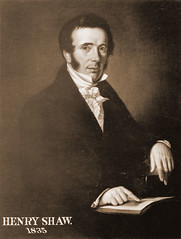
HENRY Shaw publicly opened THE GARDEN in June of 1859 when St. Louis was wasn’t even 100 years old.
Having a place for scientific botany, beauty, and conservation was quite remarkable for St. Louis. It became one of the nation’s oldest and most celebrated botanical gardens. How Henry Shaw, and later St. Louis City, acquired the botanical garden land is quite interesting. After Henry died in 1889 he left a very comprehensive will that was published in the paper. The last line of the prelude caught my eye and had me curious.
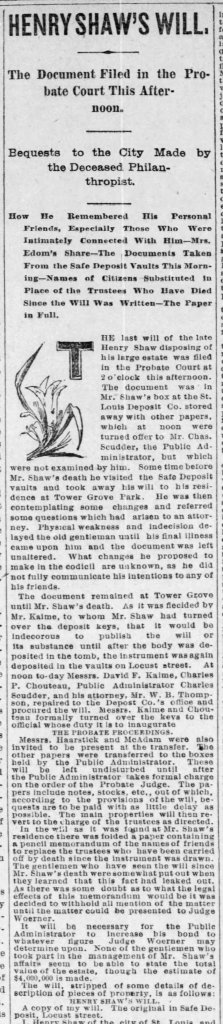
The last line read, ‘The will, stripped of some details of description of pieces of property, is as follows:’
I immediately understood this to mean that there were pieces of property that Henry didn’t have deeds for. Soon I came to understand that the missing legal deeds were for the Missouri Botanical Garden land.
Within 5 years of Henry Shaws death there was a lawsuit brewing in St. Louis Circuit Court.
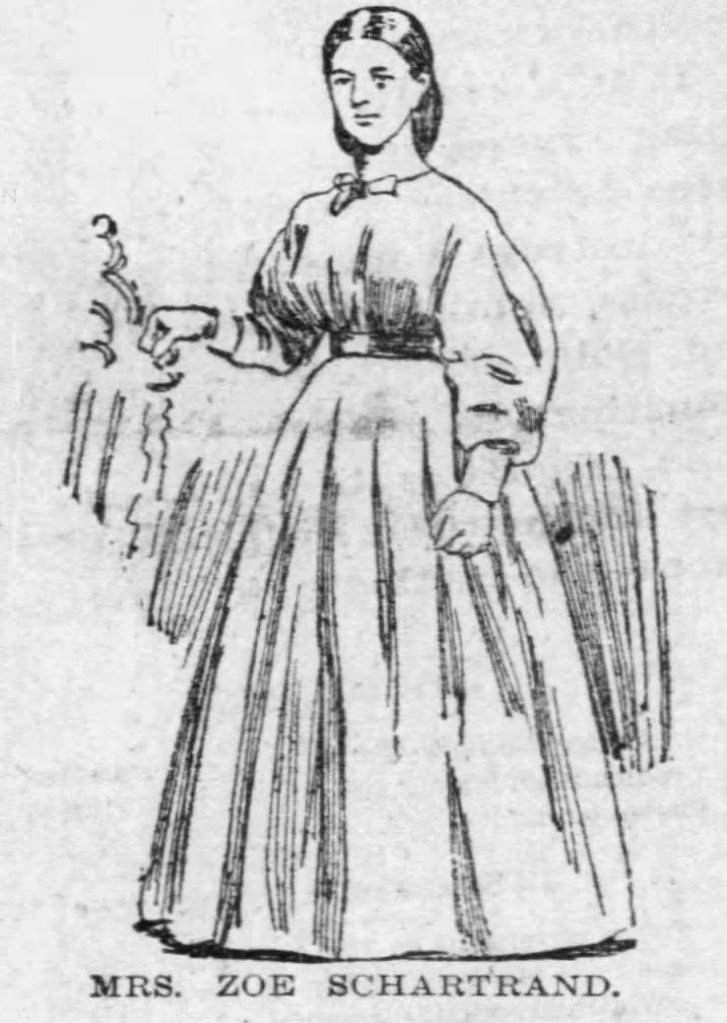


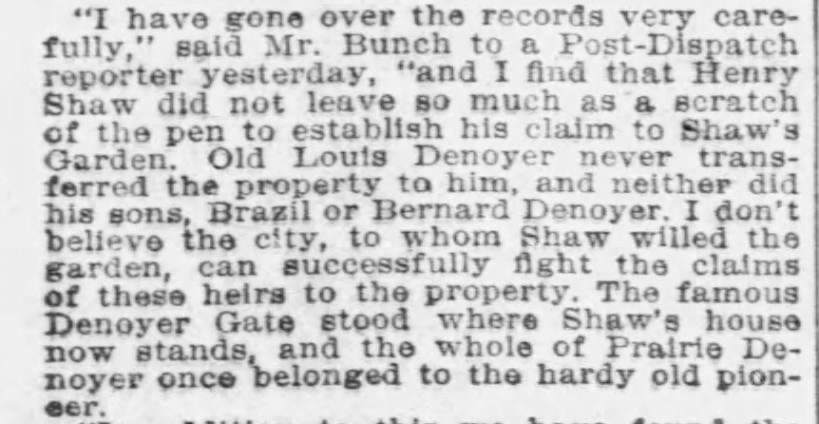
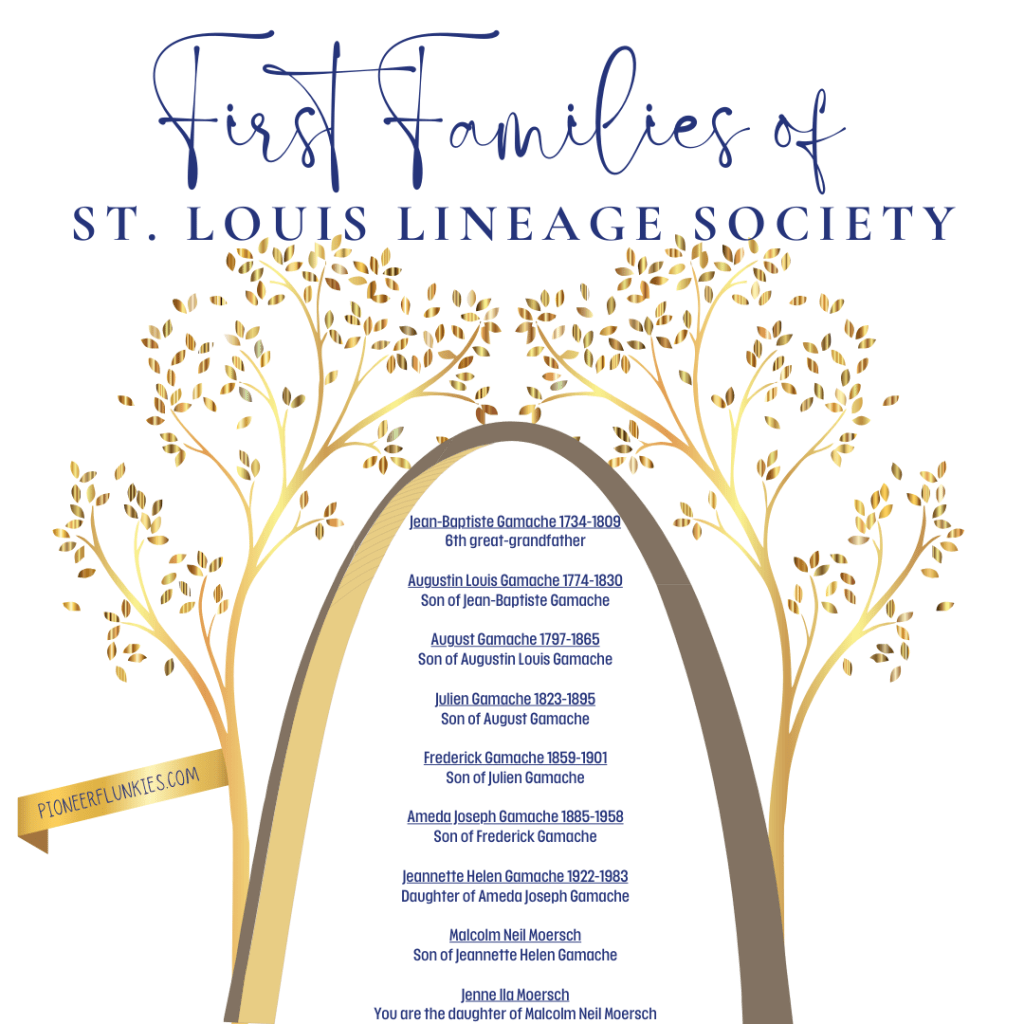
The family of Louis Denoyer (a pioneer settler in the St. Louis area) had a grievance. They claimed to have the title to the Missouri Botanical Garden property through old Spanish and French land grants. Three of the heirs were Mrs. Zoe Shartrand, Mrs. Wilson Gamache, and Mrs. Mary Howard as posted above. Their attorney, Harrison K. Bunch, stated that the original deed was made out to Denoyer by the Captain and Chief Civil Commandant of Upper Louisiana Amos Stoddard.
When the Louisiana purchase was made between france and the U.S., Napoleon bonaparte insisted that all land claims under spanish or french grants should be respected.
rootsofdiscovery.me
Spanish and French land grants were given between 1680 and 1803 as they controlled much of the area during those years. As time passed it got harder for recipients to defend ownership of the grants. Typically, if the original owner didn’t file exact titles to their lands in a timely fashion, their families had a hard time sorting it out in the legal system. Many of the these land grants are available on microfilm as part of the Missouri Digital Heritage at the Missouri State Archives and in the History and Genealogy Department at St. Louis County Library Headquarters.
“French and Spanish governments ruled the St. Louis area before the Louisiana Purchase in 1803 and provided land grants to the early settlers. These land grants were typically vast and covered a lot of territory and made it hard for the settlers to keep track of their properties. Unfortunately 70% of the early settlers were of the old rule of deeded documents were all you needed but failure to record land titles, coupled with inadequate surveys and incomplete titles, created bitter and contentious struggles over actual ownership of land after the United States purchased the Louisiana territory in 1803 and Congress attempted to confirm legitimate claims and prevent fraudulent speculation.”
Missouri Digital Heritage https://www.sos.mo.gov/mdh/
The Denoyer family located a 98 year old living witness to the Botanical Garden claim. She recalled that the garden land was originally surveyed for Louis Denoyer by a member of the Chouteau family. The heirs and witness claim that no deed to the property was ever given by Denoyer to Shaw but an agreement was laid out between them. The land was to revert back or be bought at a fair price and no written agreement was found to be with either party.
The heirs claimed that the land was being held without the slightest right simply because it was willed illegally by the deceased to the city.
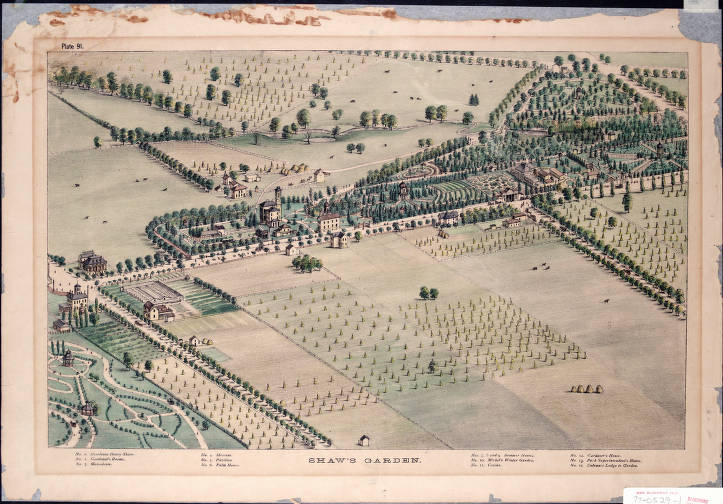
photo courtesy of https://mdh.contentdm.oclc.org/ rootsofdiscovery.me
It was written that Louis Denoyer lacked precaution and was a kind and trusting person. The papers printed that kindness can sometimes turn to carelessness if you fail to get agreements in writing. Denoyer lived in a time that a deed was all you needed. That was not the case in the modern Gilded age of his heirs.
The United States economy was then accelerating at breakneck speeds with new factories, railroads, and mining.
To make matters harder for Louis Denoyer’s heirs he didn’t explicitly list all his land in his own will. The family seemed to have a lot of evidence on their side. They had proof to legitimize the original land claim but the validity of those deeds may have come too late.
It is true that Louis Denoyer owned the land that the Missouri Botanical Gardens was situated. Yet, like many Spanish and French land grant cases went, it may not have been enough to continue a lawsuit with the city of St. Louis. The garden land may have been illegally willed to the city but it came with much of Henry Shaws vast wealth. He included it to help run the garden for years to come. I imagine that added to the upward battle of the heirs.
Unfortunately, this is where my research has ended. I haven’t had luck finding out if this case ever made it to court. I have one last location to check and will update if I find out more. Should the city of St. Louis have paid for the property at its current value for the time?
I wrote about another lawsuit and this one involved Jefferson Barracks Land! Read about that here!
Ever tried Hot Wassail? Its such a comforting drink on a cold day. Check out the recipe here!







 Roots of Discovery
Leave a comment